



The first phases of a pilot scientific study of the GSR phenomenon have been completed.
The research was carried out by the Center for Bioelectric Neurointerfaces of the National Research University Higher School of Economics (NRU HSE) under the guidance of Professor, Doctor of Science A. E. Osadchy in partnership with the company Brainstart, a resident of the Skolkovo Foundation.
The project was based on three key principles:
- Compliance with modern scientific standards.
- Strict compliance with the law.
- Maximum objectivity – including a control (placebo) group.
Today we are ready to share with you the first results of the study.
Study of the influence of GSR practice on human electrophysiological parameters
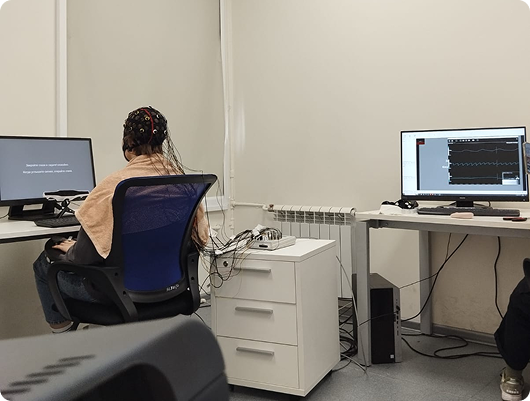
During the study, full-fledged GSR sessions were conducted with the participation of an experienced specialist. Using the GSR technique, a symptom was “wound up”, after which a session was conducted. During the session, as well as before and after work, the physiological and psychological parameters of the participants were recorded according to the following parameters:
- galvanic skin response (GSR),
- photoplethysmogram (PPG),
- electromyography (EMG),
- oculography,
- respiratory activity,
- electroencephalogram (EEG),
- psychological questionnaires (PANAS, STAI).
Research methods refer to scientifically confirmed and accepted in international practice. They reproducible and, taken together, provide high statistical reliability of the results.
These methods allow not only to record subjective sensations, but measure real changes in the human body and brain, occurring during deep inner work. With their help you can objectively observe how they are reflected in the body’s reaction, in brain function, in physiology and emotional state.
Research has proven that a GSR session:
- relieves stress;
- significantly relaxes physiologically;
- increases the power of the EEG theta rhythm in the frontal region of the cerebral cortex;
- facilitates control over automatic emotional behavior, helping to suppress habitual emotional reactions in favor of more conscious actions;
- positively correlates with the success of emotion regulation strategies, especially such as cognitive reappraisal;
- may be associated with a decrease in addictive behavior and improved emotional well-being.
Conclusion:
GSR is able to effectively activate self-referential and regulatory processes, making it a potentially useful tool in psychotherapeutic practice.
Scientific work is an important step towards integrating GSR into the social field.
We will continue this direction and keep you updated.
We thank everyone who participated: GSR specialists, organizers, subjects, as well as Dmitry Ustinov, the author of the methodology, whose ideas formed the basis of the research design.
If you plan to publish this research in the media, distribute this information to a wider audience, or contact government agencies, please first coordinate this with the GSR administration.